
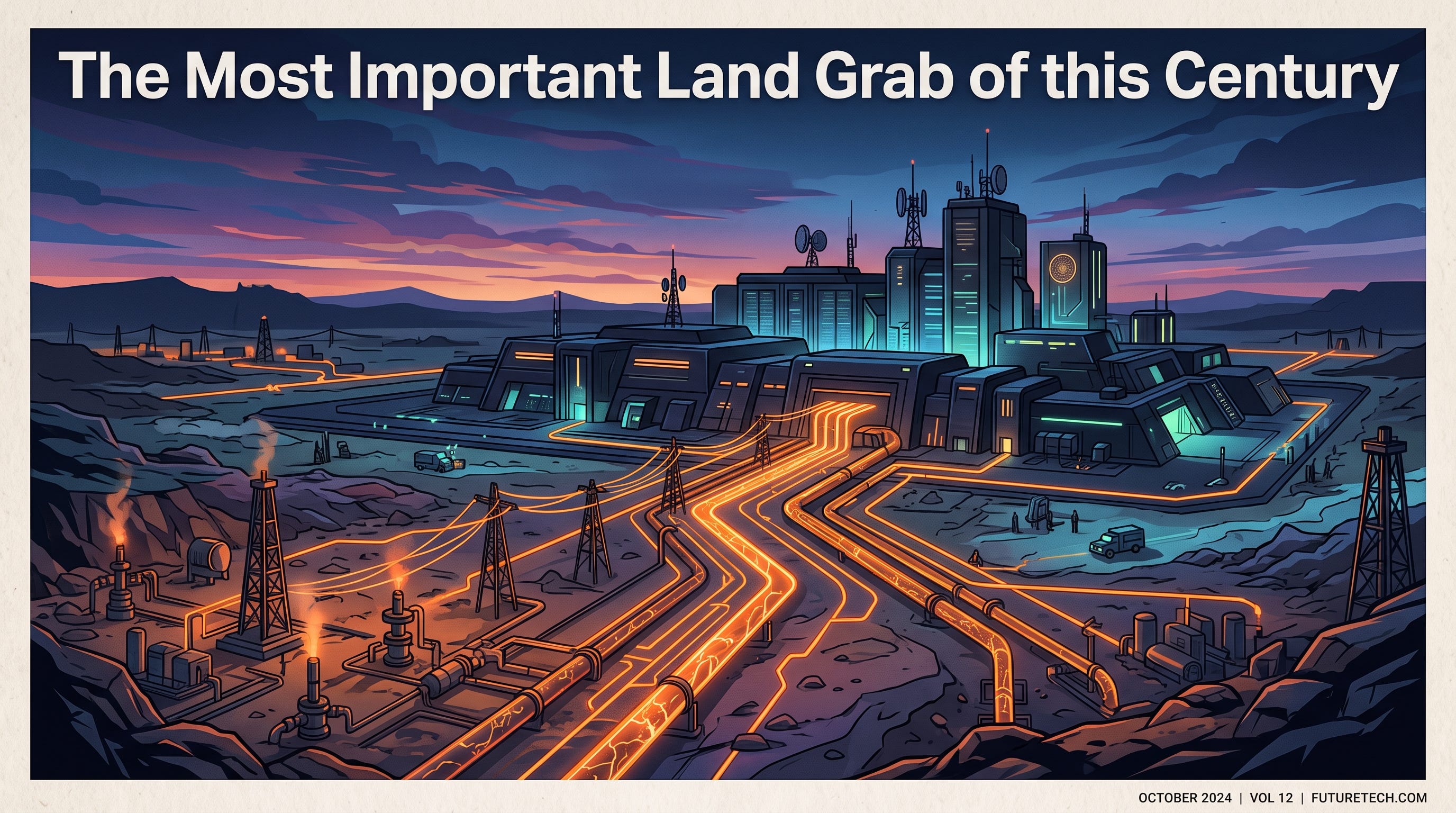
A quiet, aggressive scramble for real estate is sweeping across the globe. It is not a run on farmland, luxury residential towers, or commercial urban cores. It is the race for Datacenter Land—and specifically, the rare acreage that comes equipped with or sits directly atop high-capacity energy assets.
Driven by the explosive compute demands of Generative AI and frontier model scaling, hyperscalers and capital pools are buying up millions of acres. What looks like a standard real estate cycle on the surface is actually an unprecedented physical land grab—a preemptive land lockup designed to secure the physical bottlenecks of the digital age.
Datacenter Land: The New Utility Asset
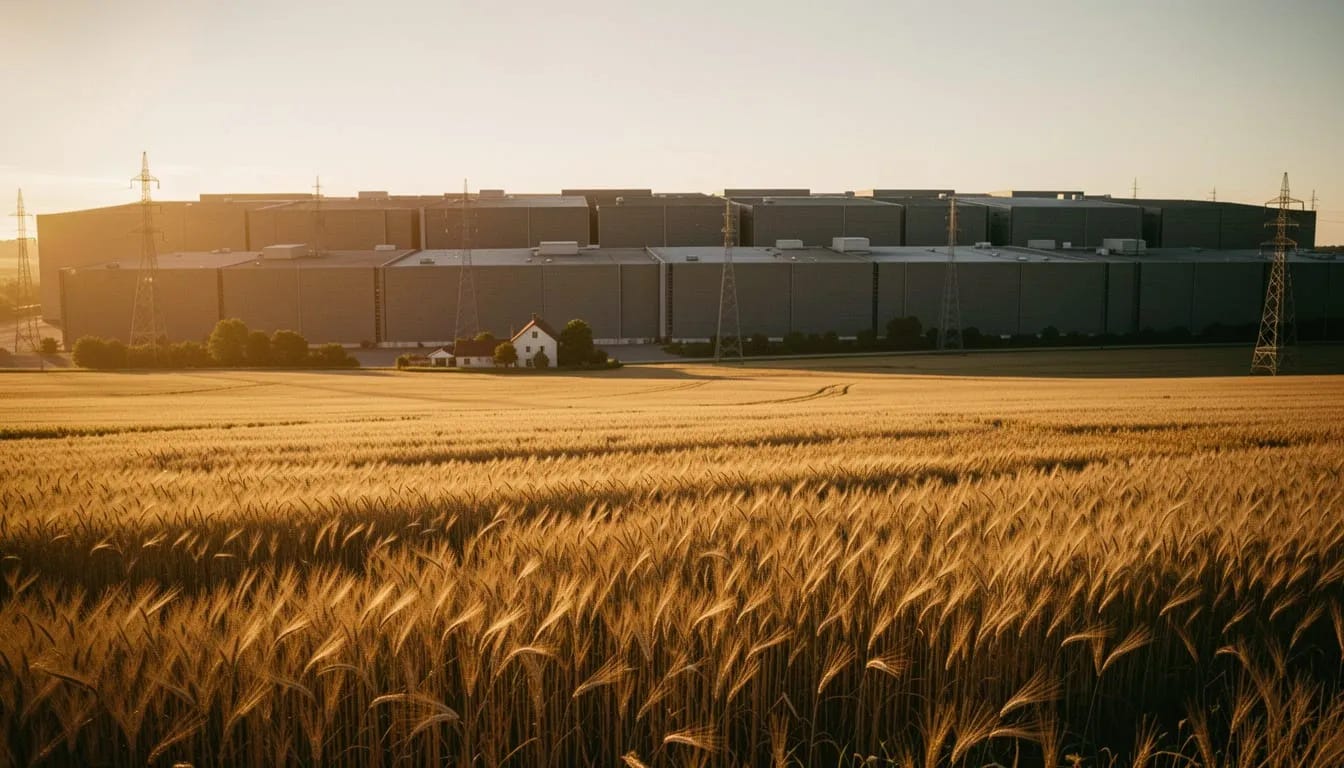
For decades, data center site selection prioritized proximity to fiber trunks, low tax jurisdictions, and low latency to major metro centers. AI compute changed that equation overnight. Modern training and inference runs require mega-campuses spanning hundreds of acres capable of supporting 100 Megawatts (MW) to multiple Gigawatts (GW) of continuous draw.
As a result, datacenter land is no longer priced or evaluated purely as industrial real estate; it is evaluated as a synthetic utility asset. The land itself is merely the vehicle; the real value lies in the natural energy deposits, behind-the-meter generation potential, water rights, and power sub-stations anchored to the parcel.
The Scale Shift: Traditional cloud hubs (e.g., Northern Virginia, Frankfurt, Dublin) were built on 10–30 MW incremental builds. Frontier AI campuses are demanding 500 MW to 2 GW single-site footprints, pushing developers into rural greenfield locations near nuclear facilities, natural gas basins, or dedicated high-voltage lines.
Preemptive Banking: Hyperscalers are acquiring land 5 to 10 years ahead of actual construction, securing “powered land” to lock out competitors and ensure continuous build pipelines.
What a Gigawatt is Roughly Worth

The industry has quietly changed the unit it uses to forecast the future. Demand is no longer measured in raw chip counts, or even in billions of dollars of capital expenditure. It is calculated in gigawatts—and then converted into economics.
According to NVIDIA’s internal projections, a single gigawatt of datacenter capacity generated roughly $18 billion in hardware revenue during the Hopper era. Under the Blackwell architecture, that same gigawatt yields $25 billion. By the time Vera Rubin scales, a gigawatt represents $40 billion in value to the chipmaker. In just two hardware cycles, the economic density of a single unit of power has more than doubled.
That single metric is what transforms powered acreage from a standard real estate story into a high-stakes industrial land grab. It explains why the scramble for land no longer looks like property development—it looks like energy extraction.
There is an obvious tension here that the market prefers to gloss over. Rubin is pitched to buyers on the promise of radically higher throughput per megawatt and lower cost per token. Yet from the exact same stage, it is marketed to investors as commanding double the revenue per gigawatt. Both claims can technically co-exist—provided total token output explodes by orders of magnitude. But when efficiency gains and price hikes share the same podium, the customer is ultimately paying for the yield.
Building out that gigawatt is its own capital marathon. Estimates from Lambda CEO Stephen Balaban outline the brutal bill of materials required to bring a gigawatt online:
On-Site Power Generation: $2B – $3B
Datacenter Shell & Electrical Fit-Out: $10B – $15B
Server Racks & Silicon Accelerators: $35B – $45B
All in, a gigawatt campus requires $50 billion to $60 billion in upfront commitment—nearly three-quarters of which goes straight into silicon.
And that brings us to the core arithmetic underpinning the entire buildout: the land and the power are the single cheapest line items in the entire project, yet they are the only components that money alone cannot instantly manufacture.
Beyond the Grid: Energy Co-Location & Technical Efficiency
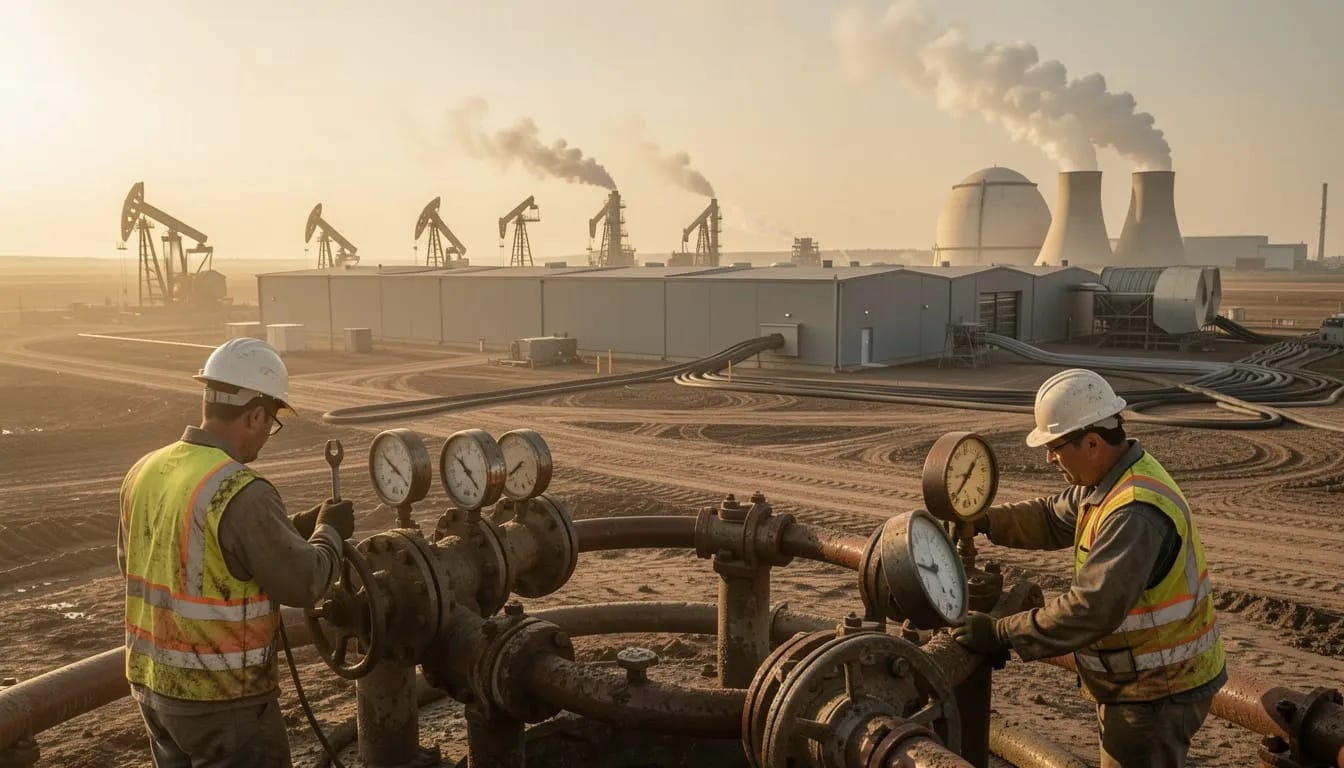
The strategy around powering Datacenter Land has thus fundamentally evolved. Operators are no longer simply waiting for utility grid interconnects—they are innovating on both power sourcing and power delivery:
1. Direct Co-Location on Natural Energy Sources
Rather than building near populated areas and relying on municipal utilities, hyperscalers are situating data centers directly on top of primary energy sources.
Behind-the-Meter Natural Gas: Projects like Stargate and other mega-scale developments are positioning facilities directly over major natural gas fields, utilizing microturbines or dedicated gas-fired plants to generate power on-site.
Nuclear and Geothermal Assets: Operators are buying up acreage directly adjacent to active nuclear plants or leveraging deep geothermal wells, bypassing public grid transmission lines entirely to eliminate grid congestion delays (which can reach 4–7 years).
2. Microgrids & Independent Power Generation Units
Hyperscalers are morphing into independent power producers (IPPs). Modern gigawatt campuses are routinely deployed alongside dedicated generation units, including combined-cycle gas turbines (CCGT), modular reactors, and large-scale battery energy storage systems (BESS) to ensure 99.999% uptime without relying on local power distribution networks.
3. High-Efficiency DC Architecture & Power Conversion
At the rack and facility level, power delivery is undergoing a structural overhaul to eliminate energy loss:
The Transition to Direct Current (DC): Traditional data centers step down high-voltage AC grid power through multiple conversion stages (AC → DC → AC →DC) before reaching the GPU chip, burning 10–15% of total power as waste heat. Next-generation facilities feed medium-voltage DC power directly into the server rows.
Advanced Conversion Efficiency: Silicon carbide (SiC) and gallium nitride (GaN) power electronics, combined with 48V/380V DC distribution, drastically reduce conversion steps, raising overall facility efficiency and allowing more raw megawatt capacity to be delivered straight to compute units rather than lost as heat.
The Physical Footprint Shifts: Rack power densities have jumped by nearly two orders of magnitude. At 100kW+ per rack, traditional AC distribution inside the server room breaks down, forcing the shift to high-voltage Direct Current (DC) microgrids. High-density liquid cooling compresses a megawatt of compute into a fraction of the physical floor space—meaning the building is no longer giant because the server racks are big; it is giant because of the heavy cooling equipment, switchgear, and acoustic noise-mitigation structures required to keep it alive.
4. The Power Scavenger Alternative
Not everyone is competing at the same auction. Beside the hyperscalers bidding up large, firm baseload sites sits a second, counter-cyclical strategy: power scavenging.
Instead of fighting for pristine 100% uptime interconnects, scavenger operators explicitly seek out cheap, stranded, or intermittent power—fragmented across secondary sites that are down a meaningful percentage of the time. While useless for synchronous frontier model training, this un-bid capacity is exceptionally cheap for asynchronous, background inference and batch processing. The bet trades power reliability for control-plane resilience—the same classic trade mini-mills made against integrated steel.
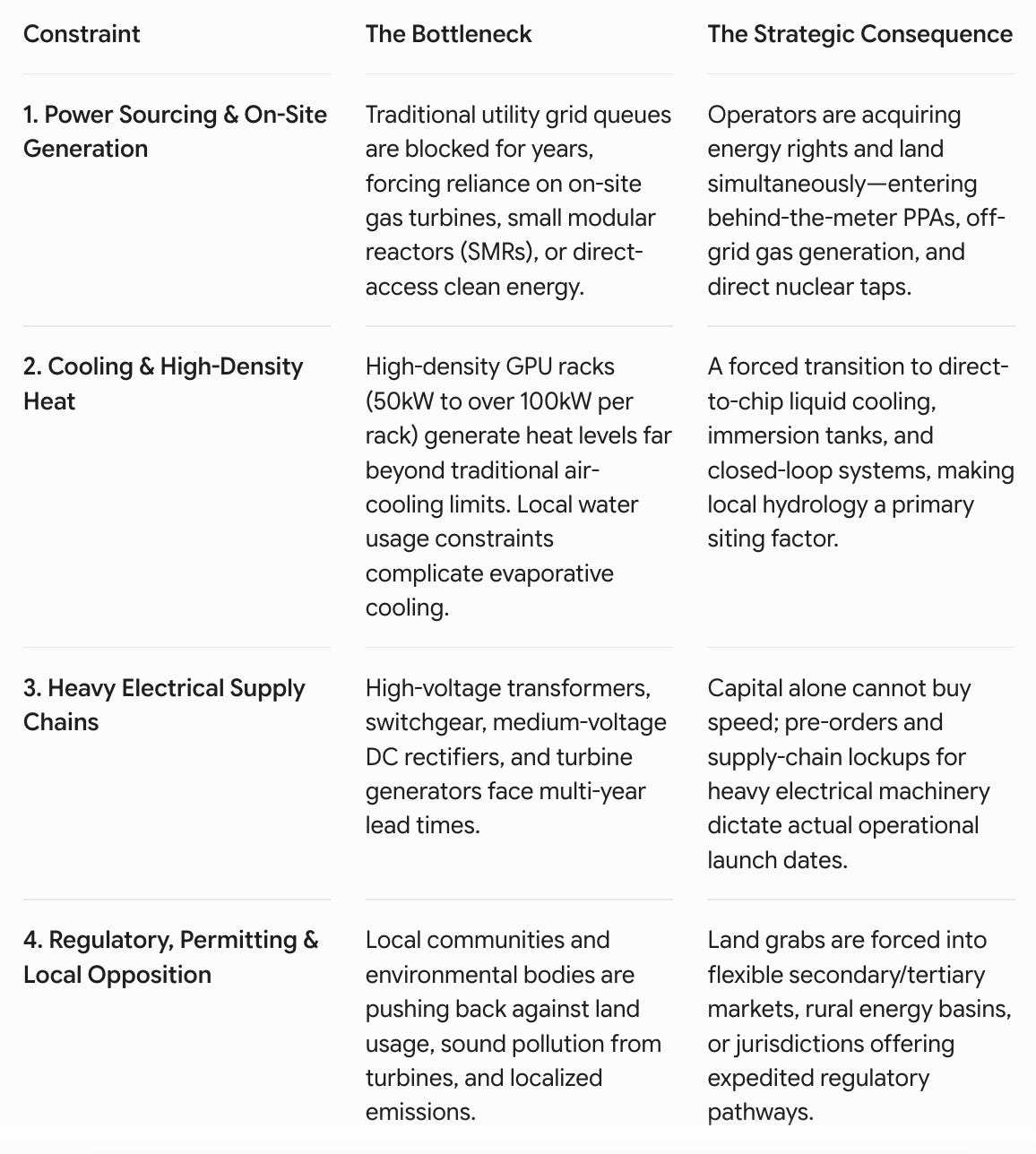
The 4 Constraints
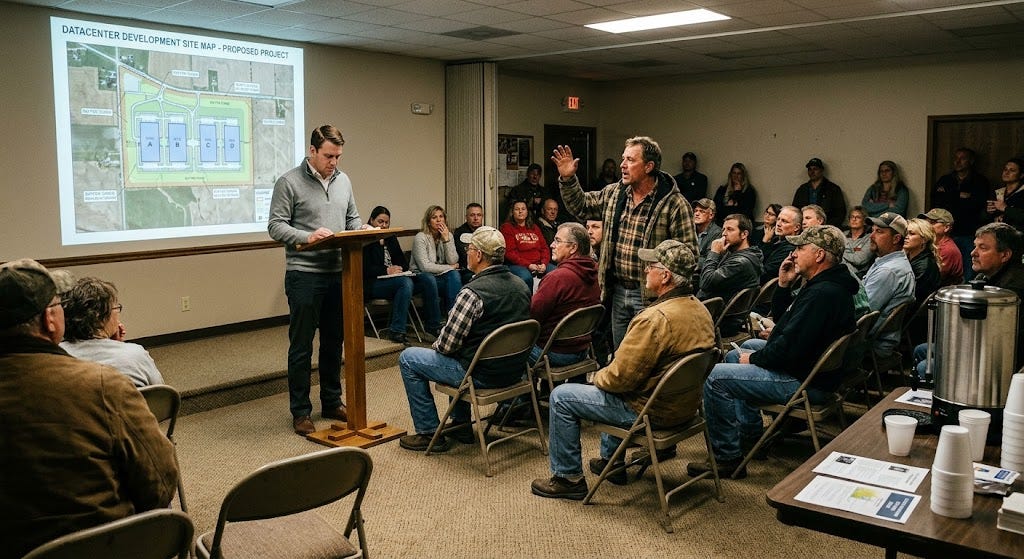
Even with on-site power generation and efficiency breakthroughs, scaling physical infrastructure to match algorithmic ambition faces four hard real-world bottlenecks:
The Binding Constraint is Permission
Chips can be ordered. Turbines can be ordered—eventually. Permission cannot be ordered, and it is now the primary variable deciding which gigawatts actually get built.
Five independent operators, sharing nothing but the problem, name the exact same friction: zoning, route approvals, and local land sign-offs. Consider Oracle’s multi-gigawatt Project Jupiter in New Mexico. The project wasn’t slowed by a lack of capital, demand, or turbines; its timeline slipped by close to six months because the state land office repeatedly delayed route approvals for the Green Chile natural gas pipeline crossing state land.
When local permission becomes the binding bottleneck, capital doesn’t wait around—it moves. Buildout pipelines are already shifting toward Mexico, Australia, and sovereign energy basins where regulatory fast-tracking matches the pace of model iteration. The most binding constraint in the industry is the only one nobody can chart.
The Mag7 / Hyperscale / Frontier Lab Positioning
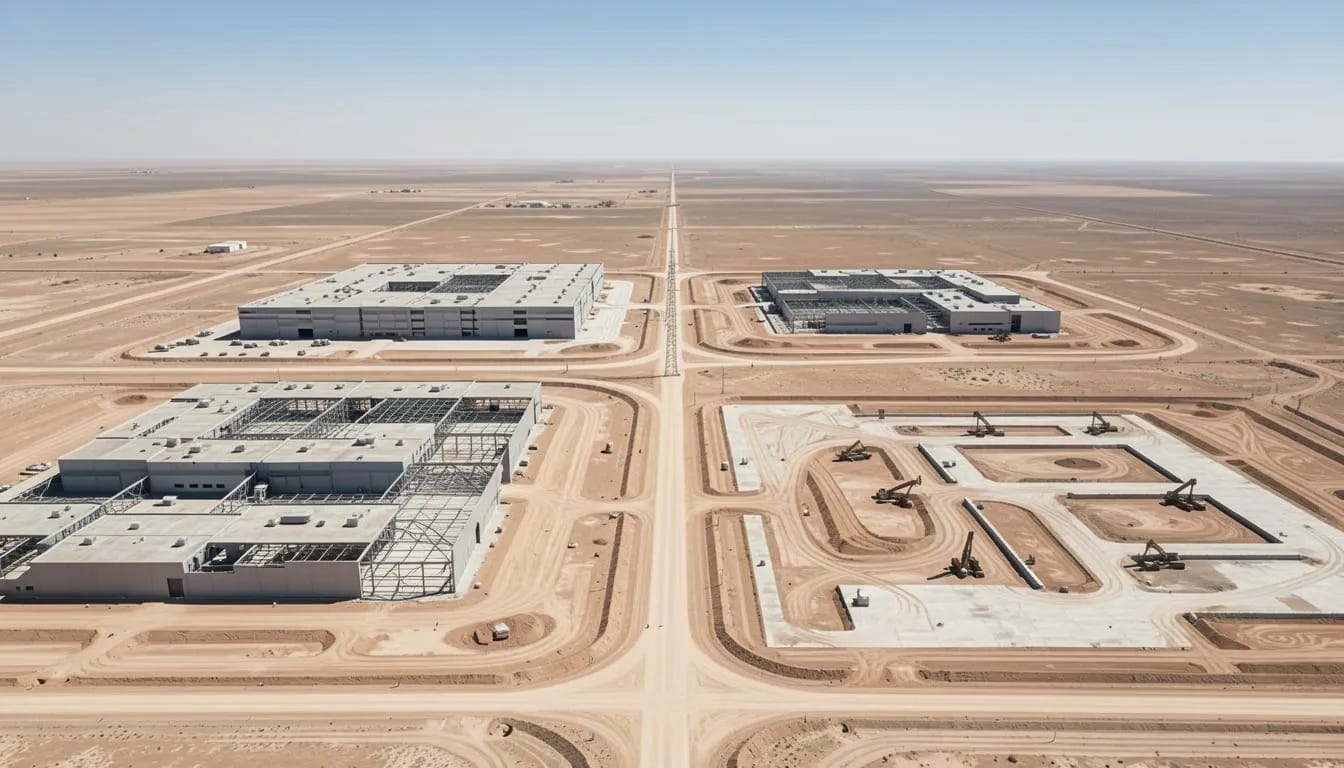
As physical land, energy deposits, and power equipment tighten, the strategic moves among mega-cap tech giants and frontier labs have diverged into distinct strategies:
Microsoft
Positioning: Aggressive Co-Location & Decoupling Flex.
Strategy: Pursuing direct nuclear and gas co-location deals (e.g., Constellation/Three Mile Island PPA) while expanding Azure’s footprint. While maintaining non-exclusive IP access to OpenAI through 2032, Microsoft is simultaneously building internal model capabilities via Microsoft AI (MAI) and deploying optimized DC power infrastructure across new builds.
Capital Approach: Restructuring leases and balancing capex spend to keep reported capital intensity flexible without sacrificing sheer physical footprint growth.
Amazon (AWS)
Positioning: Nuclear Assets, Silicon Integration & Explicit Capital Triggers.
Strategy: AWS pioneered nuclear co-location with its acquisition of the Talen Energy Cumulus data center campus attached directly to the Susquehanna nuclear plant. Simultaneously, AWS is anchoring massive builds like Project Rainier ($11bn, 2.25GW footprint) around custom Annapurna silicon (Trainium2) co-developed with Anthropic.
Capital Approach: Taking a disciplined “capital kill-switch” stance: aggressively securing 1.5x forward land/power coverage, but explicitly maintaining the operational flexibility to slow deployment if end-user demand normalizes.
Alphabet (Google)
Positioning: Low-Cost Vertical Integration & Long-Tenor Commitments.
Strategy: Leverages proprietary TPU architectures alongside early adoption of high-efficiency DC power distribution and advanced cooling. Google drives immense internal inference through Search (AI Overviews) while running low-cost compute offerings to strain capital-constrained rivals.
Capital Approach: The land grab is already sitting in Alphabet’s SEC filings. Recent disclosures reveal energy “take-or-pay” contracts with terms running up to 26 years—into the 2050s. While compute commitments turn over on 3-to-5-year cycles, Google is guaranteeing energy liabilities decades out, quietly laying bare its long-term inference horizon.
Meta
Positioning: Ad-Engine Monetization & Defensive Open-Weights.
Strategy: Uses open-weight models (Llama series) to commoditize underlying foundation models, driving compute efficiency directly into its core ad-ranking and recommendation architectures (like GEM/Andromeda).
Capital Approach: Absorbing massive capex jumps for custom DC facilities and GPU clusters to fuel core engagement and ad pricing improvements, even while balancing high current operating costs against third-party compute dependencies.
Apple
Positioning: Endpoint Arbitrage & Distributed Inference.
Strategy: Apple stands as the lone counter-example in the cohort—looking at the scramble for land and power and declining to buy much of either. Instead of building gigawatt-scale campuses to generate every marginal token, Apple leverages the billions of powered endpoints its customers have already bought. Small inferences execute locally on-device within a few watts; medium workloads route to custom silicon running under its Private Cloud Compute architecture; and frontier model requests are licensed from third parties rather than trained from scratch.
Capital Approach: An explicit wager that controlling the distribution point (the device in the user’s pocket) is structurally more defensible than owning the production point. If everyday AI tasks remain low-wattage, Apple bypasses the largest capital buildout in corporate history. If frontier models require gigawatts of central compute indefinitely, Apple will be forced to rent the raw capacity it chose not to build—from its direct competitors, at their price.
Tesla / SpaceX (Elon Musk)
Positioning: Fluid Execution Velocity & Off-Grid Arbitrage.
Strategy: Arrived late to the gigawatt buildout and converted late entry into a structural advantage. Lacking legacy data center footprints or half-depreciated hardware fleets, Musk builds exclusively against the current performance-per-watt frontier. This yields energy costs per token among the lowest in the industry, while securing priority silicon allocations directly from hardware vendors who prioritize rapid deployment over long procurement cycles.
Capital Approach: Attacks the traditional infrastructure financing model itself. The typical buildout relies on decade-long take-or-pay energy contracts and rigid cloud leases to satisfy debt underwriters. By driving capital payback periods down to under a year through rapid deployment and high-margin compute monetization, Musk operates without long-term off-take commitments—offering short-notice terms that destabilize traditional hyperscale leasing models.
The Orbital Wildcard: SpaceX offers the ultimate long-term dissent from terrestrial land grabs. If ground-based buildouts remain bound by municipal permitting delays, water rights, and power grid interconnect queues, orbital compute proposes moving the infrastructure altogether—tapping uninterrupted solar energy and radiating heat into space without a local county planning board.
Frontier Labs (OpenAI, Anthropic, Independent AI Labs)
Positioning: Compute Buyers & Land-Bound Tenants.
Strategy: Lacking traditional enterprise balance sheets or direct utility infrastructure, frontier labs rely on hyperscaler alliances or joint ventures (e.g., Stargate concepts) to guarantee their gigawatt pipelines.
Vulnerability: Highly sensitive to physical delivery delays, turbine supply chains, and power availability. Their survival hinges on turning physical compute access into model superiority before capital markets tire of underwriting gigawatt-scale infrastructure.
The race to buy up land and power is fundamentally altering tech balance sheets. The winner of the AI era may not simply be the company with the best software architecture, but the one holding the deeds to the world’s most valuable powered acreage.
Energy-per-Token: The Core Operational Metric
As datacenter power limits bind, the core operational metric across every hyperscaler shifts from raw cost per FLOP to Energy per Token (Joules per Token).
Under a hard site wattage cap—whatever the local generation or interconnect queue allows—efficiency is no longer merely a line-item cost saving. Efficiency is capacity. If a custom ASIC or a high-voltage DC distribution system delivers 30% more compute per watt, you fit 30% more active model capacity inside the exact same physical perimeter without needing a second land permit.
This closes the strategic loop: if a single gigawatt yields the hardware vendor twice what it did two years ago, and the only way to expand a capped site is to spend fewer joules per token, then custom silicon design and energy land banking are not two separate domains. They are the exact same strategy.
What do Energy, Compute and Geopolitical alignment have in common?
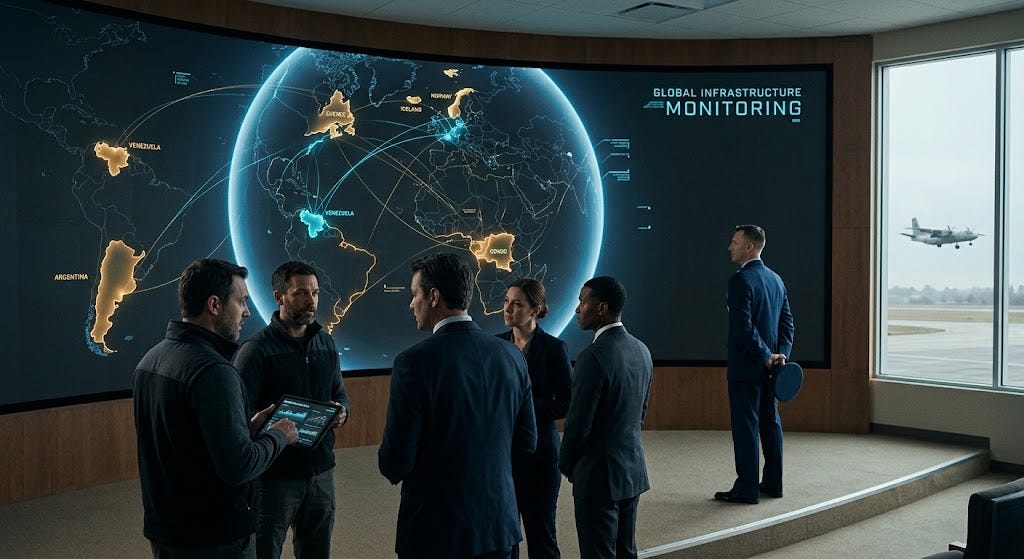
Traditional tech investors are entering the macro space in a big way. This movement is at the convergence of three intersecting dynamics: the search for off-grid energy for compute, physical asset investing, and geopolitical alignment.
The report of Peter Thiel buying a ~1% stake in Vista Energy via his fund Thiel Macro ($76M position in 1.2M ADS), is one such example. The full breakdown of Thiel’s Argentina play reveals how this setup compares to similar global “co-located energy/compute” land grabs.
1. The Real Story Behind Thiel, Vista Energy, and Milei
While headline speculation linked the Vista Energy purchase to direct datacenter construction in Argentina, regulatory filings and portfolio tracking reveal a broader, two-part strategic play:
The Energy Bet (Vaca Muerta): Vista Energy (NYSE: VIST) is the leading independent shale oil and gas producer operating out of Vaca Muerta in Patagonia—the world’s second-largest shale gas basin. Thiel’s purchase is part of a broader macro shift into generation and grid assets (his 13F also showed multi-million-dollar positions in Vistra, X-Energy, AEP, and FirstEnergy). He is treating primary energy production as the central bottleneck of the decades ahead.
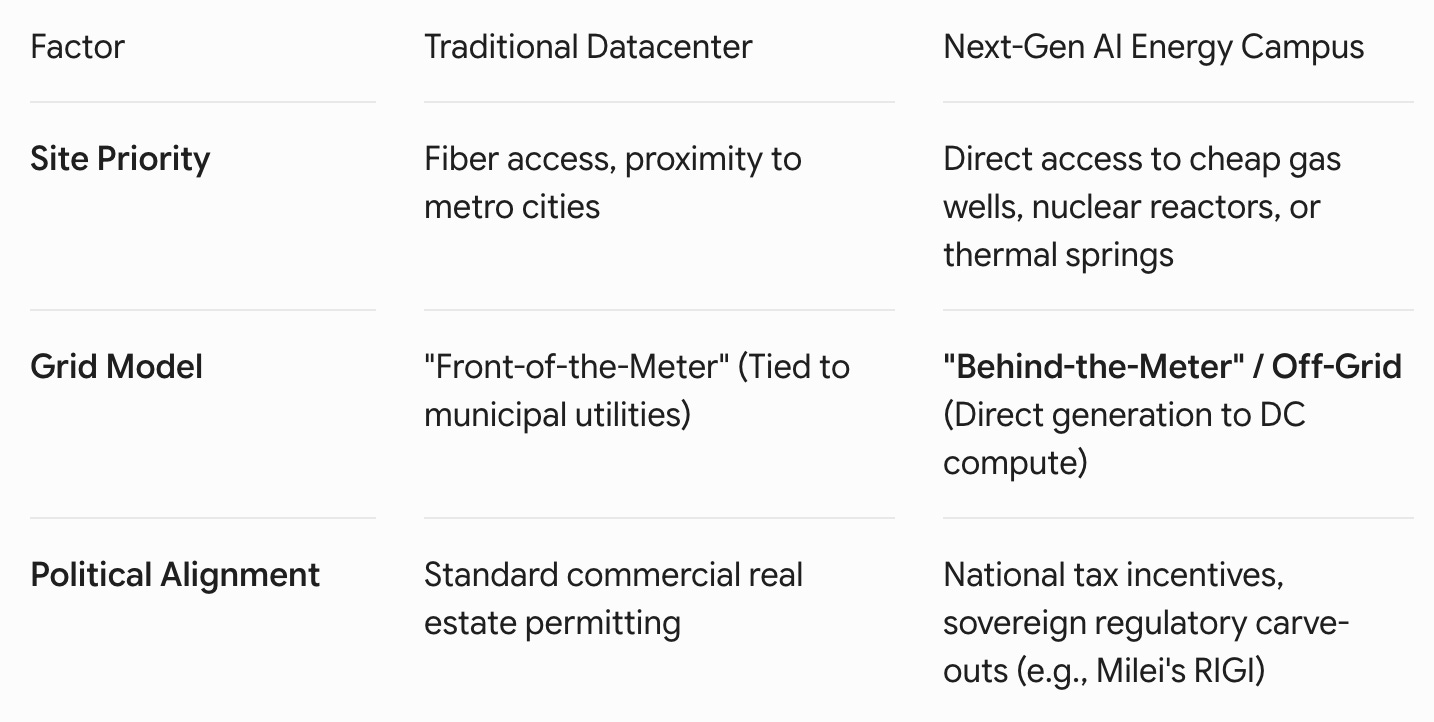
The “Milei Anarcho-Capitalist Lab”: Thiel’s move follows multiple sit-down meetings with President Javier Milei. Milei introduced the RIGI (Incentive Regime for Large Investments) and a “Super RIGI” framework to offer 30-year tax stability, zero export tariffs, and regulatory immunity to tech, energy, small nuclear (SMR), and AI infrastructure projects exceeding $1B.
The Compute Connection: Argentina’s combination of cheap, un-interconnected natural gas in Vaca Muerta, cold Patagonian climates, and a deregulated “Super RIGI” framework makes it a prime candidate for behind-the-meter AI compute campuses directly adjacent to gas wellheads.
2. Global Precedents: Datacenters Placed Directly on Energy Sources
Thiel’s positioning in Argentina is part of a global movement where hyperscalers and capital pools are bypassing utility grid queues (which can take 4–7 years) by placing data centers “behind the meter”—directly on top of natural energy reserves or dedicated power plants.
Here are the clearest global parallels to the Thiel/Argentina setup:
A. Natural Gas Wellheads & Off-Grid Gas (United States)
xAI Colossus (Memphis, TN): Elon Musk built the 100k GPU “Colossus” cluster in under 122 days by parking massive aeroderivative, mobile natural-gas turbines directly outside the facility, bypassing traditional local utility interconnect processes.
Ohio & Marcellus Shale Basins: Developers across Ohio and Pennsylvania (Meta, EdgeConneX) are securing direct access to natural gas fields, placing multi-hundred-megawatt gas turbines directly on the industrial footprint to feed DC power directly into server halls.
B. Direct Nuclear Co-Location
Amazon (AWS) & Talen Energy (Cumulus Data Center): AWS acquired the Cumulus data center campus in Pennsylvania for $650M. The facility sits directly adjacent to the 2.5 GW Susquehanna Nuclear Power Plant, receiving zero-carbon power off-grid without paying utility transmission fees.
Microsoft & Constellation Energy (Three Mile Island): Microsoft signed a 20-year PPA to restart Unit 1 of the Crane Clean Energy Center (Three Mile Island), dedicating 100% of the reactor’s 835 MW output exclusively to Microsoft Azure workloads.
C. Geothermal Assets (Iceland, Kenya, & New Zealand)
Rift Valley Geothermal (Kenya): EcoCloud and KenGen built a 100% green data center directly inside the Olkaria Geothermal Field in the Great Rift Valley, drawing power directly from steam wells beneath the earth to eliminate transport loss and grid reliance.
Icelandic Basalts: Datacenters like Borealis Data Center sit atop volcanic geothermal wells in Iceland, tapping continuous baseload energy alongside natural ambient cooling.
D. Middle East & North Africa (Flare Gas and Solar Basins)
UAE & Saudi Arabia (ADNOC / Aramco Flare Gas): Entities in the Gulf are building compute container modules directly at oilfield flares and gas processing plants, turning excess stranded natural gas into high-density local compute for regional LLM training.
3. Summary of the Trend
The combination of cheap land, sovereign energy reserves, and aggressive deregulation makes Argentina an attractive testing ground.
The New Sovereign Infrastructure
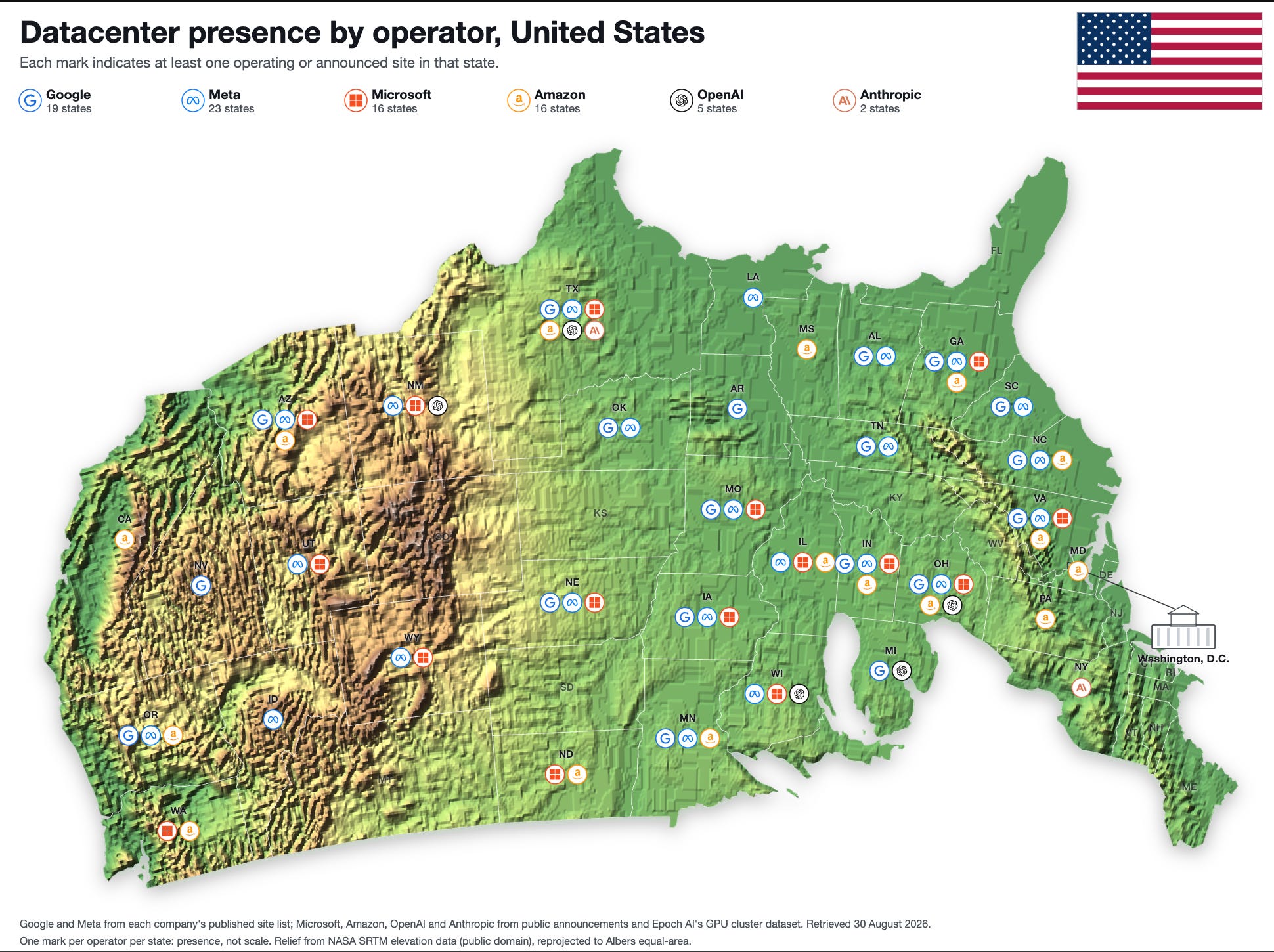
The scramble for datacenter land is not a temporary real estate bubble driven by speculative tech capital. It represents a fundamental restructuring of global digital infrastructure, where primary energy production, local permitting, and physical land control have become the core determinants of artificial intelligence capabilities.
The winner of this cycle will not simply be the lab with the most elegant algorithmic architecture, nor the hyperscaler with the slickest enterprise software distribution. The winners will be the entities that successfully convert balance sheet strength into long-term control over powered acreage—locking down the physical bedrock upon which the next century’s intelligence will run.